Support bone formation
before fragility manifests.
A formulation developed to promote osteoblastic differentiation and the formation of new organic bone matrix at a biological stage where bone loss has already begun but there are no strategies aimed at supporting osteoblastogenesis.
Born from a clinical need
Before overt fragility there is a biological phase with significant bone loss, where osteoanabolic therapy is not yet indicated.
Bone renews continuously
Each day our skeleton is remodeled through the coordinated activity of two cell populations.
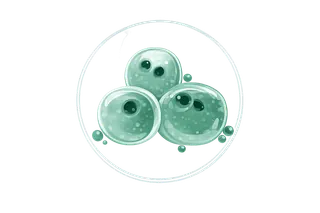
Bone formation
Osteoblasts: build new bone matrix.
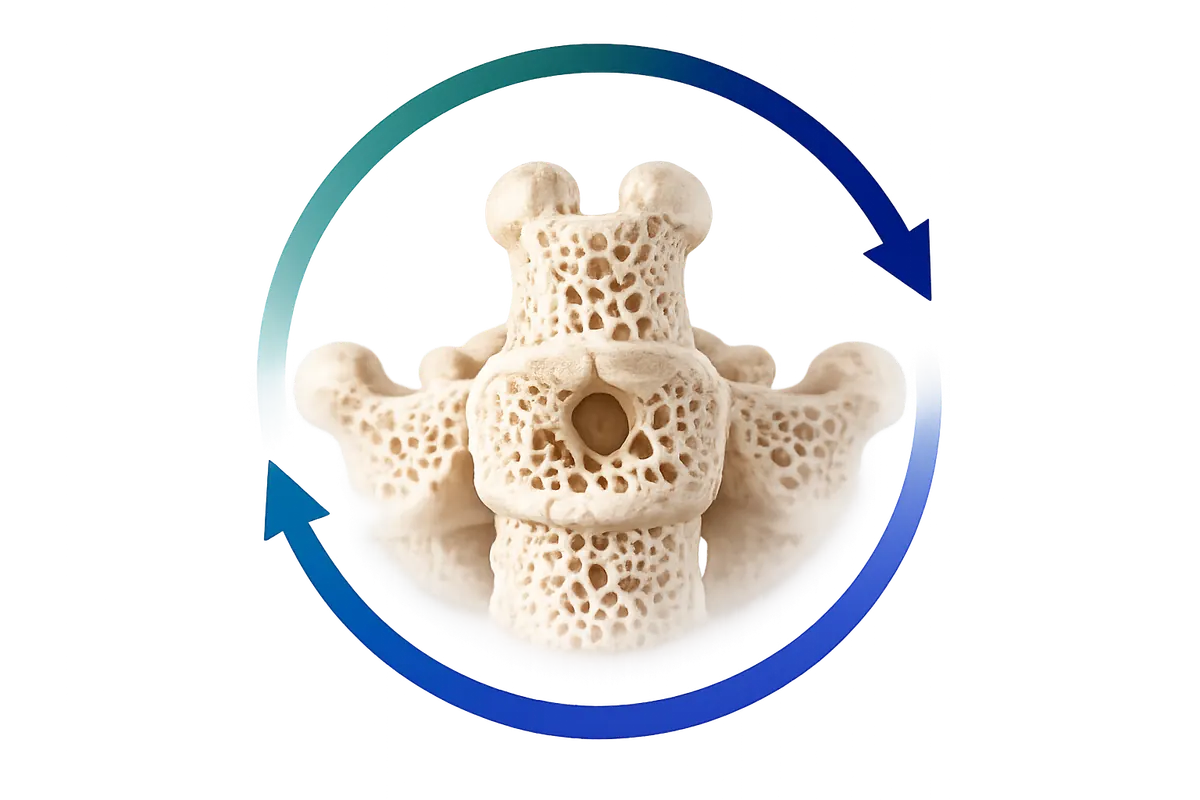

Bone resorption
Osteoclasts: resorb aged bone tissue.
Bone health depends on two processes.
Bone formation
Bone resorption
To maintain its biological integrity, bone tissue needs a balance between both components.
With age and menopause this balance changes
Estrogen reduction
Loss of estrogen protection alters bone remodeling physiology.
Inflammaging
Biological aging promotes a low-grade chronic inflammatory state that influences the bone microenvironment.
Osteoblastic potential
Osteoblastic progenitor cells progressively reduce their capacity to produce new bone matrix.
Remodeling imbalance
Bone formation and resorption no longer proceed with the same efficiency.
Bone is not just
a calcium deposit
It is a biological structure that must be continuously rebuilt.
The formation of new organic matrix represents the essential biological prerequisite for any physiological mineralization process.
For many years attention has focused mainly on controlling bone resorption and maintaining adequate levels of calcium and vitamin D;
These approaches are important; however, the formation of new organic matrix represents the first biological step of every bone-building process;
In the presence of osteopenia/osteoporosis, between the physiological decline of bone mass and the onset of fragility, there is a biological window of intervention that is NOT adequately addressed and of particular clinical interest.